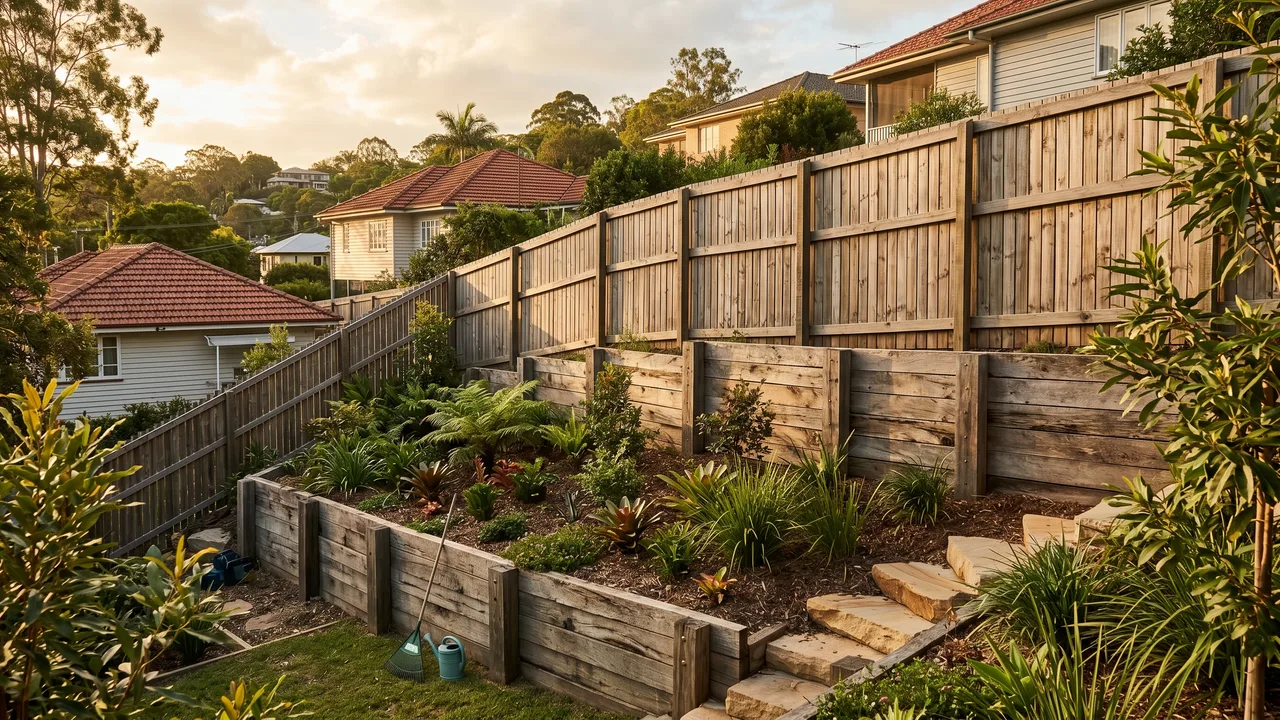
Fencing
Retaining and Boundary Fencing.
Retaining and Boundary Fencing in Indooroopilly
Indooroopilly and the surrounding suburbs sit on some of Brisbane's most varied terrain. Blocks in Taringa, St Lucia and Chelmer often drop sharply from street level to backyard, and Corinda or Graceville homes sometimes step down across two or three terraces. When a site like that needs a fence, you can't just plant posts in the ground and call it done. You need a structure that holds the earth back and defines the boundary, working as one unit rather than two separate jobs bolted together.
That's what a combined retaining and boundary fence does.
What the Work Actually Involves
A retaining and boundary fence is, at its core, a fence that also carries a lateral load — the weight and pressure of soil on one side. The structural demands are higher than a standard fence, so the physical work reflects that.
Typically, the contractor will:
- Assess the slope and soil type before quoting. Clay-heavy soil (common in the Inner West) pushes harder than sandy fill, and that affects post sizing and footing depth.
- Excavate footings to the depth required by the retaining height. A 600 mm retained height might need posts set 900 mm into the ground; taller retaining sections go deeper.
- Install the primary structural posts — usually treated hardwood (like hardwood H4 or H5 class) or galvanised steel, depending on the design and finish you're after.
- Fix horizontal rails or sleepers on the uphill side to hold the soil, then attach fence panels or palings on the downhill face.
- Install drainage behind the retained section. This part matters. Without weep holes or agricultural drainage pipe, water pressure builds behind the wall and eventually pushes it over.
- Finish the fence face to match your chosen material — timber paling, Colorbond panel, or aluminium slat.
The work requires excavation equipment in some cases, and on steeper blocks in suburbs like Yeronga or Fairfield, there may be hand-digging involved where machine access is limited.
When You Need This Service
The clearest sign is a sloped block where your existing fence is leaning, cracking or sitting on a step that's starting to crumble. Other signs include:
- Soil visibly washing under or around your current fence during heavy rain
- A boundary with a neighbour where your yard is noticeably higher than theirs (or vice versa)
- A new fence quote where the contractor flags that ground levels need addressing before panels go in
- An old timber retaining wall that's rotting out but also happens to be your boundary fence
There's no particular season for retaining work, but it's worth planning ahead of Brisbane's wet season (roughly November to March). Soil is harder to work when it's waterlogged, and some contractors are fully booked through summer storm repair work.
What It Costs in Brisbane
Combined retaining and boundary fencing is typically the most expensive fencing category because it involves structural engineering loads, deeper footings and more labour. As a rough guide for Indooroopilly-area properties:
- Low retaining height (under 600 mm) with standard fence above: $350 to $550 per lineal metre
- Medium retaining height (600 mm to 1 m) with fence above: $550 to $900 per lineal metre
- Over 1 m of retained height: $900 to $1,500+ per lineal metre, and may require a private certifier or council approval depending on your local requirements
Most full jobs land somewhere between $4,000 and $12,000 depending on length, materials and site difficulty. Corner blocks or steep falls can push a job toward the upper end.
What moves the price:
- Height of the retained section
- Soil type and how hard excavation is
- Whether drainage installation is included
- Fence material chosen (hardwood timber costs more than treated pine; Colorbond is mid-range)
- Site access — a tight side passage in Sherwood means more hand labour than an open block in Moorooka
What's Included in a Quote vs What Costs Extra
A solid quote should include: excavation, footings, structural posts, rails, drainage behind the wall, and the fence panels or palings themselves.
Watch for these items that sometimes sit outside the base quote:
- Removal and disposal of the old fence or existing retaining wall
- Rock breaking if excavation hits hard substrate
- Engineering certificates (required in some cases for retaining walls over 1 m)
- Painting or oiling of timber (often a separate finish coat)
- Any council development approval fees
Ask specifically about each of these before you sign anything.
Is This the Right Service for Your Property?
If your block is flat and you simply need a new fence along a level boundary, a standard timber or Colorbond fence is the right choice. This service is for you if:
- There's a meaningful height difference across your boundary line
- You've had problems with soil movement, water runoff or a leaning existing fence
- A previous quote mentioned "retaining" as part of what's needed
If you're unsure, describe the slope when you enquire and a good contractor will tell you honestly which way to go.
A Note on Safety and Qualifications
Retaining walls over certain heights are regulated under Queensland building laws. As a general rule, a retaining wall over 1 m typically requires building approval in Brisbane City Council areas. The fence above that may need its own assessment too. The contractors we connect you with carry the appropriate licences and public liability insurance for this type of structural work. Ask to see both before work starts — any legitimate tradesperson will hand them over without hesitation.
If you'd like a clear-eyed assessment of your block and a straight quote, get in touch. Describing the slope, the length of the run and what's there currently gives the contractor enough to work with before the first site visit.
Quick answers
Frequently asked.
Do I need council approval for a retaining wall and fence on my Indooroopilly block?
Can I use Colorbond panels on a retaining and boundary fence?
Why does drainage matter so much in a retaining fence?
How do I know whether I need a retaining fence or just a standard fence?
What is the typical timeframe to complete a retaining and boundary fence job?
Is this a job I can do myself to save money?
Ready to book
Quickest is by phone.
Up-front pricing on the call. Booked in one go. No site visit needed.