Fencing guide
Sloped blocks make fencing harder. Here is what you need to know.
Sloped Blocks Make Fencing Harder. Here Is What You Need to Know.
Yes, a sloped block genuinely does make fencing more complicated, more expensive, and more time-consuming to plan. The gradient forces every decision — material, style, footing depth, panel layout — to work against gravity instead of with it. Once you understand why, the options in front of you become a lot clearer.
Why Slope Changes Everything About a Fence
A fence on flat ground is straightforward. Posts go in at equal depth, rails sit level, panels drop in. Done.
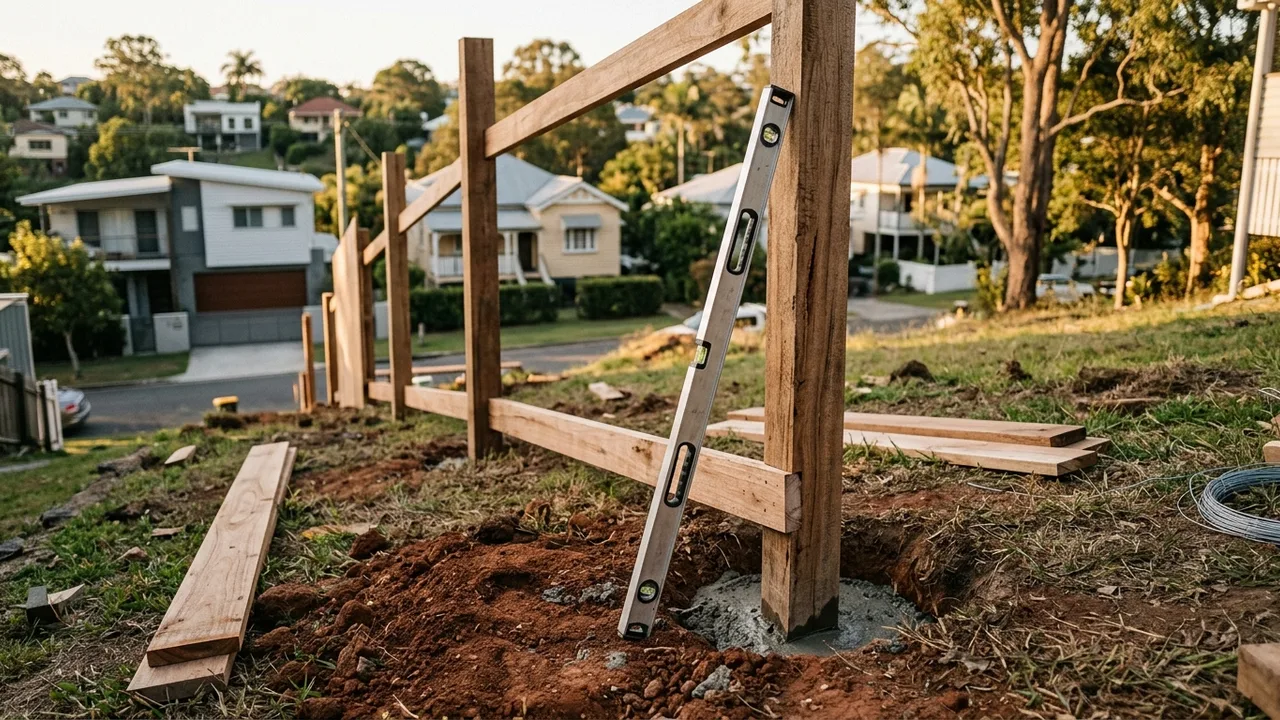
On a sloped block, none of that holds. The ground falls away at different rates along the boundary line, which means each post sits in a slightly different relationship to the panels around it. If you ignore that and just run a flat fence line across a slope, you end up with large gaps under the bottom rail at the low end. That is a problem for privacy, pool compliance, and keeping dogs in the yard.
The two main ways to handle slope are raked (or stepped) fencing and stepped (or drop-panel) fencing. The terminology sometimes gets swapped around, so here is what each actually means in practice:
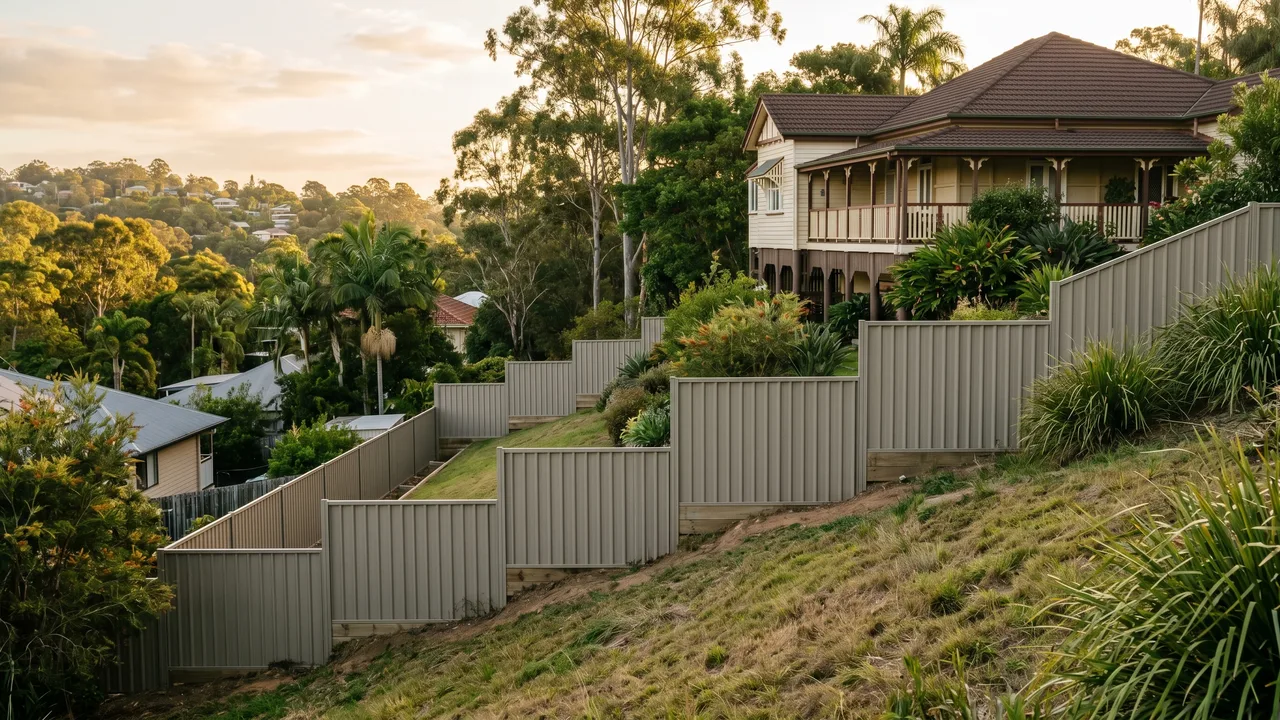
- Raked fencing means the top and bottom rails of each panel follow the angle of the ground. The fence looks like a parallelogram in cross-section. It works well for Colorbond steel and some aluminium systems.
- Stepped fencing means each panel is installed level, but drops down in steps as the fence progresses downhill. This is the standard approach for timber palings, glass pool panels, and most pre-fabricated systems.
Each approach has trade-offs. Raked fencing gives a cleaner look on a gradual slope, but it requires materials that can be cut or manufactured at an angle. Stepped fencing is easier to build from standard materials, but the steps leave triangular gaps at ground level that often need infill panels, concrete, or garden edging underneath.
What Brisbane's Inner West Terrain Actually Looks Like
If your property is in Indooroopilly, Taringa, St Lucia, Chelmer, or Sherwood, there is a good chance your block drops toward a creek line or sits on a ridge that was carved out when the suburb was originally cleared and subdivided. The Brisbane River meanders through this part of the city, and the surrounding terrain follows it. Blocks in these suburbs commonly fall half a metre to two metres from front to back, or side to side.
Yeronga, Graceville, and Corinda sit on slightly flatter alluvial ground closer to the river flats, but even there you will find blocks with a distinct cross-fall. Fairfield and Moorooka trend hillier again, with some properties on older sub-divided lots that have retaining walls already built in from decades past.
This matters because it affects what you need before a fencer even sets a post. On a steep block, you may need a retaining wall integrated into the fence line rather than a standalone fence sitting on bare earth. A combined retaining-and-fence solution costs more upfront, typically $5,000 to $12,000 depending on height and length, but it solves both problems at once and is usually the structurally correct answer for drops over about 600 mm.
The Four Main Fencing Materials and How They Handle Slope
Colorbond steel is probably the most forgiving system for sloped sites. The panels can be raked to follow the ground angle within the manufacturer's specified limits, usually around 10 to 12 degrees depending on the system. On a steeper gradient, stepped installation is used with infill sections at the base. It is low maintenance and handles Brisbane's humidity well.
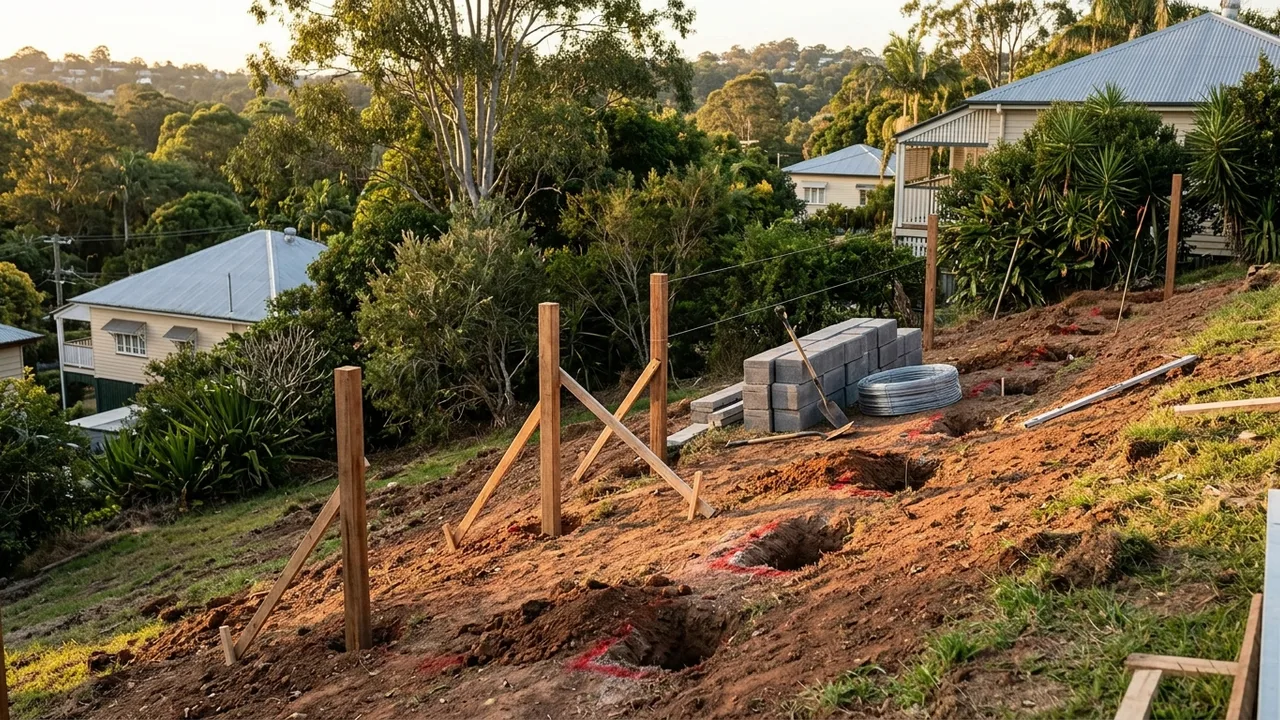
Timber (hardwood or treated pine) is flexible because it is cut on-site. A carpenter or fencer can cut palings to suit almost any ground profile, and the posts are custom-set to whatever height the terrain demands. The trade-off is labour cost, and on a complex slope, that adds up. Hardwood performs better in Brisbane's wet seasons; treated pine is cheaper but needs careful sealing to last.
Aluminium behaves similarly to Colorbond in that it relies on manufactured panels. Raking is possible within limits; beyond those limits, you step the panels. Powder-coated aluminium is a strong choice for front yards in Inner West Brisbane where street appeal matters, as it holds colour well and does not rust.
Glass pool fencing is the most demanding on sloped ground. Each panel must be plumb and the system must comply with the Queensland Development Code (MP 5.1) regardless of what the ground is doing underneath it. Posts are set into concrete footings at varying depths to maintain the correct panel height above the finished ground level. This is not a job to try on a tight budget or with an uncertified installer. Non-compliant pool fencing is a legal liability.
Footings, Posts, and Why the Soil Matters
A sloped block often means you are digging into disturbed fill at the top of the slope and into softer, sometimes wetter ground at the bottom. In older Inner West suburbs, you may also hit concrete rubble, old tree stumps, or clay that shrinks and cracks through dry summers.
As a rule of thumb, a standard 1.8 m fence post needs to be set at least 600 mm into the ground. On a sloped block, posts at the low end of a stepped fence often need to go deeper to maintain height, which means more concrete and more labour. If the soil is sandy or loose, you may need larger diameter footings.
It is worth asking any fencer you speak to whether they have dug in your street or suburb before. Experienced local operators will already know what they are likely to hit.
Cost Realities for Sloped Sites
A straightforward flat-block fence in Brisbane might run $150 to $250 per lineal metre for Colorbond or treated pine. Add a meaningful slope and that figure typically rises by 20 to 40 percent, sometimes more for steep or complex sites.
That range is wide for a reason. The variables are: how steep the fall is, how many steps or rakes are required, whether infill panels are needed, whether there is an existing retaining wall or you need one built, and how accessible the site is for equipment.
A 20-metre boundary with a 600 mm fall across it is a different job to a 20-metre boundary with a 1.5 m fall and a drainage easement running along it. Get a site inspection before accepting any quote, and ask the fencer to show you on the quote where the slope-related costs are. A quote that does not itemise infill, footings, or retaining is harder to compare.
Typical job values for sloped boundary work in this part of Brisbane sit somewhere between $2,000 for a short repair or replacement and $15,000 for a full-length complex boundary with integrated retaining.
What to Sort Out Before Work Starts
A few things will slow a job down or change its cost significantly if they are not resolved beforehand.
Boundary confirmation. On older Brisbane subdivisions, the survey peg may not be where you think it is. Having a current survey or at minimum a clear understanding of where the boundary sits saves disputes with neighbours.
Neighbour agreement. In Queensland, a dividing fence is generally a shared cost if both parties use it. On a sloped block, the question of which side the posts face and how infill sections are handled can create friction if it is not discussed early.
Council and body corporate rules. Some Inner West suburbs have character overlay provisions or are within local heritage areas. Fence height limits and material restrictions can apply. Check with Brisbane City Council before you order materials.
Drainage. A fence line can redirect surface water flow, particularly on a sloped block. Infill sections that seal the base of a fence can create ponding in wet weather. A good fencer will flag this; raise it if they do not.
A Practical Way Forward
If your block has any meaningful gradient, the single most useful thing you can do before calling anyone is to walk the boundary line and roughly measure the height difference from end to end. Even a rough estimate (half a metre, one metre, two metres) helps a fencer give you a more accurate quote over the phone and arrive better prepared.
Sloped fencing is not impossibly complicated. It just requires more planning than a flat-site job, a fencer who has done it before, and a quote that reflects the actual ground conditions. If you take those three things seriously, the result is a fence that looks intentional, holds up through Brisbane's wet seasons, and does not leave you with expensive problems two years later.
Quick answers