Fencing guide
Queensland pool fencing laws: what every homeowner must know before installing.
Queensland pool fencing laws sit under a single, non-negotiable framework: the Building Act 1975 and the associated Queensland Development Code (QDC) Mandatory Part 3.4. The short answer is that any pool in Queensland — including portable and inflatable pools holding more than 300 mm of water — must be fenced. Full stop. Knowing exactly what that fencing must look like, and what the process for certification is, can save you a painful and expensive rectification job later.
Why Queensland's pool fencing rules are stricter than most people expect
Queensland has one of the highest rates of toddler drowning in the country. That context shapes the legislation. The rules are not bureaucratic box-ticking; they are designed around the specific way young children move and behave near water.
The key document is QDC MP 3.4, which applies to all pools completed after 1 December 2010. Pools built before that date may fall under earlier standards, but any upgrade, alteration or change of ownership typically triggers a compliance assessment against the current rules. If you are buying a property with a pool anywhere in Brisbane — Sherwood, Yeronga, St Lucia, wherever — the pool barrier should be inspected before settlement, not after.
Worth knowing: local councils are responsible for inspection and enforcement. Brisbane City Council manages this across the Inner West suburbs covered here, including Indooroopilly, Taringa, Chelmer, Graceville, Corinda and the others. The council can inspect a pool barrier at any time and issue a penalty infringement notice if it is non-compliant.
The four core requirements every barrier must meet
The rules have nuance, but four requirements catch out most homeowners attempting a DIY install or a budget refresh.
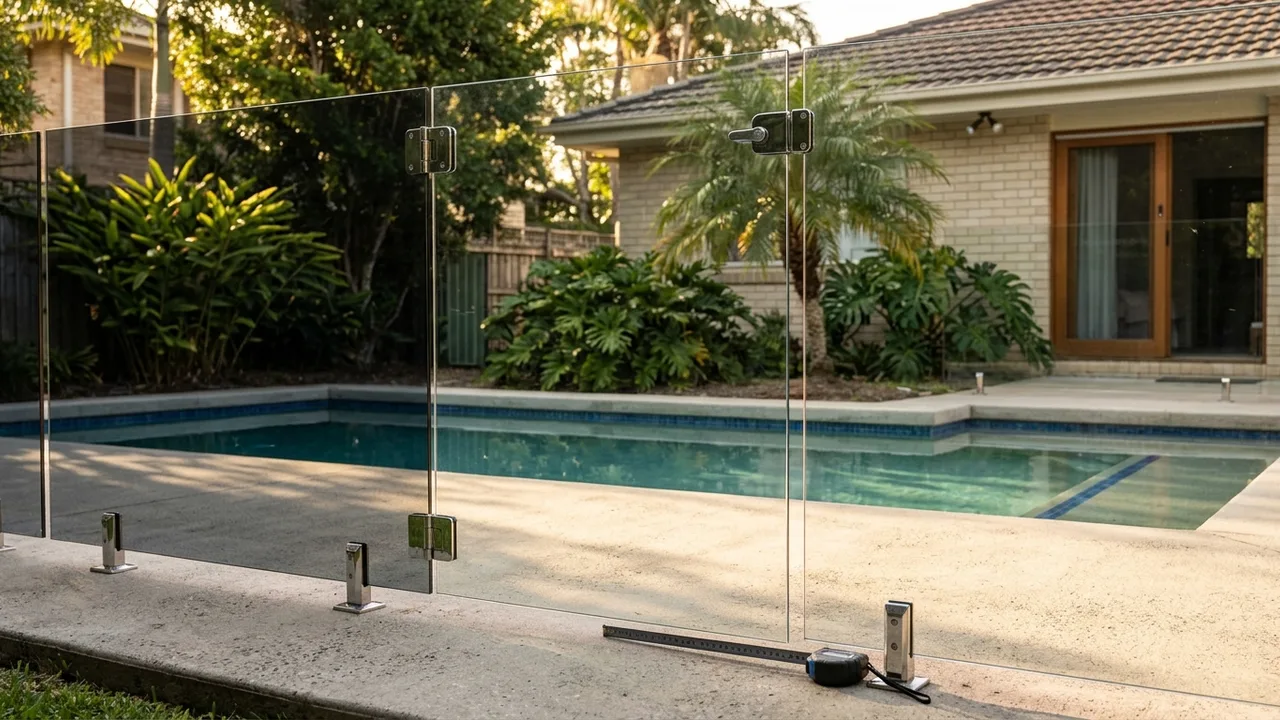
1. Height. The barrier must be at least 1200 mm high, measured from the finished ground level on the outside of the fence. On sloped blocks — common throughout Indooroopilly and Chelmer — "finished ground level" can be ambiguous. If the ground slopes up along the fence line, the height must still be measured at each point along the slope, not just at the lowest end.
2. Non-climbable zone (NCZ). There must be a 900 mm non-climbable zone on the outside of the barrier. This means no footholds, no horizontal rails, no garden furniture, no planter boxes and no trees with climbable branches within 900 mm of the fence. An agapanthus clump or a retaining wall edge placed too close will fail an inspection. This is one of the most common compliance failures on Inner West properties where established gardens are dense.
3. Gate requirements. All gates must be self-closing and self-latching. The latch must be on the pool side of the gate and positioned at least 1500 mm above ground, or it must be enclosed to prevent a child reaching through. Gates must open outward, away from the pool. A gate that swings inward fails automatically.
4. Pool isolation. The barrier must completely isolate the pool from the house and from any other structure a child could access unsupervised. A house wall can form part of the barrier, but only if the doors and windows opening into the pool area are fitted with specific compliant hardware, including alarms that sound within seven seconds of the door being opened.
Fence materials: glass vs aluminium vs other options
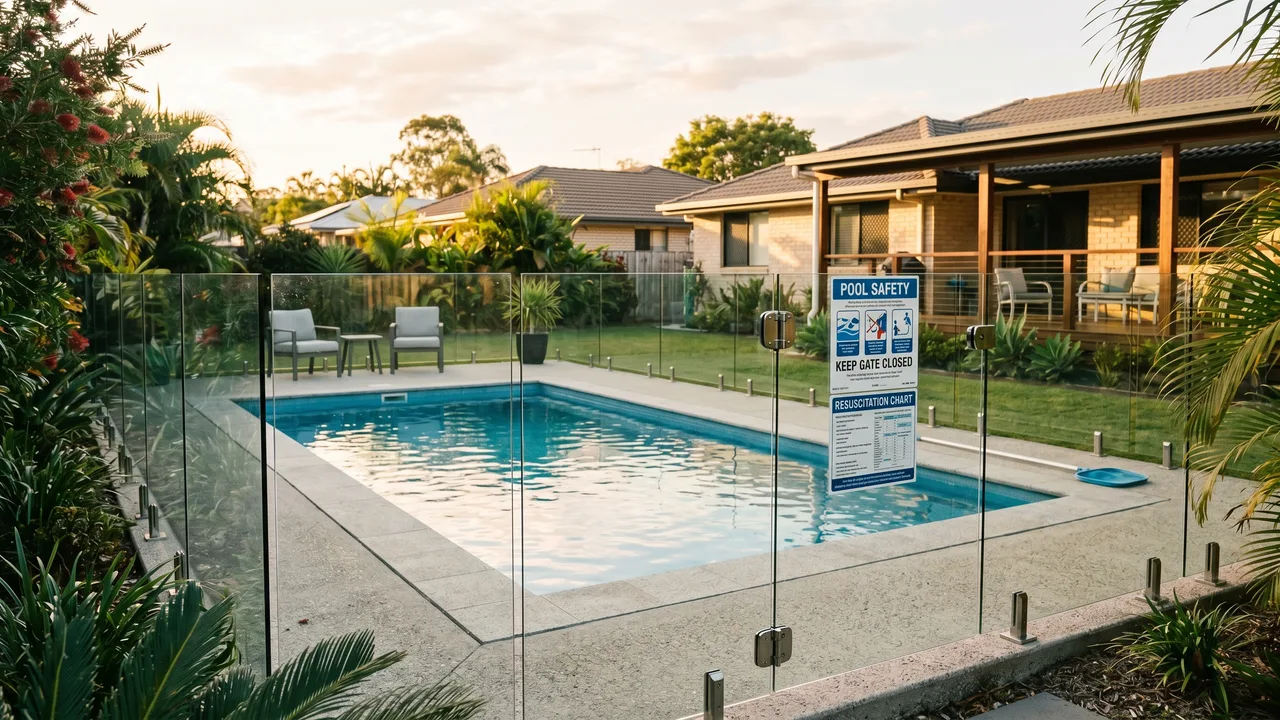
Glass pool fencing is popular for aesthetic reasons, and it is compliant when installed correctly using toughened or laminated safety glass panels at the right height and with compliant gate hardware. The appeal is obvious on a property in St Lucia or Graceville where the pool is the centrepiece of an outdoor entertaining area. The trade-off is cost: frameless glass barriers typically run more per linear metre than aluminium, and the glass needs regular cleaning to keep it looking the way it looked when new. Salt air is less of a concern here than in bayside suburbs, but organic material from trees (jacaranda, fig, frangipani) can leave staining.
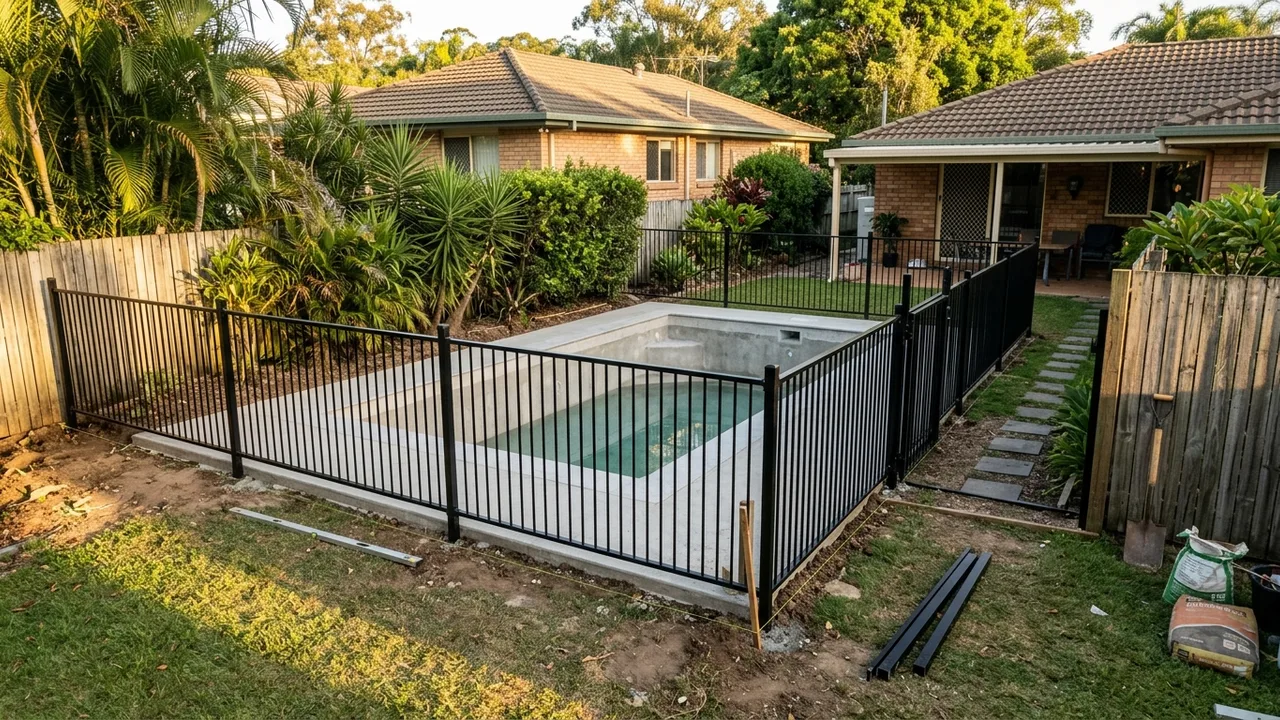
Aluminium pool fencing is typically the more practical choice for most Inner West Brisbane properties. Powder-coated aluminium does not corrode, does not warp in the heat, and the vertical picket design is inherently NCZ-compliant because there are no horizontal climbing aids. Costs vary by specification, but as a rough guide a standard aluminium pool barrier on a straightforward flat block might come in between $150 and $250 per linear metre fully installed. A sloped block, semi-frameless glass or heritage overlay requirements can push that figure higher.
Timber is generally not suitable for pool fencing. It warps, swells and can degrade at the base in contact with wet pool surrounds, which can compromise gate latching mechanisms over time.
The certification process: what actually happens
In Queensland, a swimming pool barrier must be certified by a building certifier, not just inspected by a fencing contractor. The process typically works like this:
- You engage a licensed builder or fencing contractor to install the barrier to the relevant standard.
- A private building certifier or Brisbane City Council certifier inspects the completed barrier.
- If compliant, they issue a Form 17 (pool safety certificate). This certificate is required for selling or leasing a property with a pool.
One point that trips people up: the fencing contractor's job is to build a compliant structure. The certifier's job is to confirm it. These are two separate parties. A good contractor will know the standard well enough that a single inspection is all that is needed, but the certificate itself only comes from the certifier. Factor in the certifier's fee (typically $150 to $300 in Brisbane) when budgeting.
If you are managing the project on a property in Fairfield or Moorooka and the pool area is unusual in any way, such as a sloped boundary, a retaining wall that doubles as part of the barrier, or an older Queenslander-style deck adjacent to the pool, it pays to get the certifier involved before installation begins, not after. A pre-construction discussion can save a costly rebuild.
Shared fences and neighbour obligations
If the pool barrier runs along a shared boundary, the rules around who pays for what get more layered. Under Queensland's Neighbourhood Disputes (Dividing Fences and Trees) Act 2011, general dividing fence costs are typically shared equally. But a pool barrier is not a standard dividing fence; it has compliance requirements attached to it that your neighbour has no obligation to fund simply because you want a pool.
In practice this means: if you want the shared boundary fence to serve as your pool barrier, you are likely funding the upgrade to pool-barrier standard yourself, not splitting the cost. Get legal or council advice if there is any doubt, especially if the existing fence is already a point of tension.
Common mistakes that fail inspection
A few patterns appear repeatedly on Inner West Brisbane properties:
- Garden beds or pot plants placed after installation. Homeowners landscape the pool area and inadvertently create climbable footholds beside the barrier. The NCZ rule applies permanently, not just at the time of inspection.
- Pool equipment storage. A pump housing, filter box or storage unit positioned within the NCZ can fail an inspection even if the fence itself is perfect.
- Latches that loosen over time. Self-latching gate hardware needs periodic checking. A latch that springs freely when new may need adjustment after a year or two.
- Windows and doors with compliant hardware that gets bypassed. An alarm that has been disabled or a door prop that is left in place during a party creates a non-compliant barrier for that period.
- Shade sails and pergola posts. A pergola post close to the outside of the fence can become a climbable aid. Structural changes to the pool surrounds should always be reviewed against the NCZ requirement.
A straightforward recommendation
If you are installing a new pool barrier, get quotes from contractors who carry a current Queensland Building and Construction Commission (QBCC) licence that covers fencing work, and ask specifically whether they have experience with pool safety compliance in Brisbane City Council jurisdiction. Ask them to walk you through how they handle sloped sections and gate placement before signing anything.
You do not need to understand every clause of QDC MP 3.4 yourself. You do need a contractor who does, and a certifier who will sign off independently. Rushing the job or choosing a quote that looks unusually cheap is usually where the compliance problems begin.
If you would like a local recommendation for pool fencing in the Indooroopilly area or surrounding suburbs, this service connects homeowners with experienced, vetted providers. No pressure to proceed, just a straightforward introduction.
Quick answers