Fencing guide
Can you install your own fence in Brisbane, or should you always hire a professional?
Can You Install Your Own Fence in Brisbane, or Should You Always Hire a Professional?
Yes, you can install your own fence in Brisbane for many standard situations, but whether you should depends on the job. The type of fence, your block's characteristics, and Queensland's regulatory requirements all affect that answer significantly.
What the Rules Actually Say
Brisbane City Council and Queensland state legislation set a baseline for what homeowners can do without a licensed contractor. For a standard boundary fence between two neighbours, you generally don't need a building approval if the fence is no more than 2 metres high and is not associated with a pool. That covers most timber paling and Colorbond fences on residential lots.
Where it gets complicated:
- Pool fencing is a different category entirely. Under the Building Act 1975 (Qld) and the Building Regulation 2006, pool barriers must be certified by a licensed building certifier after installation. You can build the fence yourself, but a certifier still has to inspect and approve it before your pool is legally usable. A non-compliant pool barrier creates real personal liability if something goes wrong, so most people in suburbs like St Lucia or Sherwood hire a licensed installer who handles certification as part of the job.
- Retaining walls incorporated into a fence line add another layer. In Brisbane, a retaining wall over 1 metre high typically requires a building approval. Many blocks in Indooroopilly, Taringa, and Graceville are significantly sloped, so a fence that looks straightforward on flat ground becomes a structural engineering question on a Queensland hillside.
- Dividing Fence Act disputes between neighbours don't require a professional to resolve, but the process can get messy without one. If you can't agree with your neighbour on cost-sharing, the Queensland Civil and Administrative Tribunal (QCAT) is the path forward, and that takes time and paperwork.
If you're unsure about approval requirements, Brisbane City Council's online planning and development tool is the most reliable first check.
The Real Practical Challenges of DIY Fencing
Setting aside the legal side, fencing is physically demanding and more technically demanding than it looks. Here's where most DIY fence projects run into trouble.
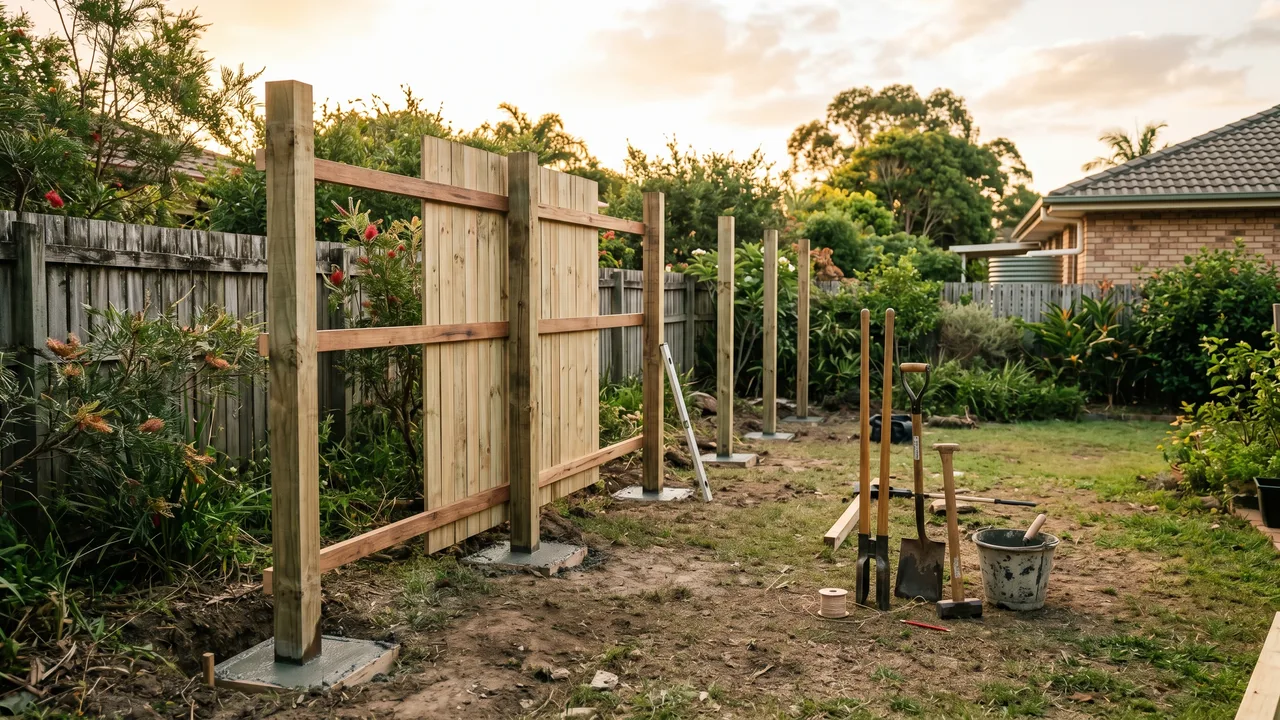
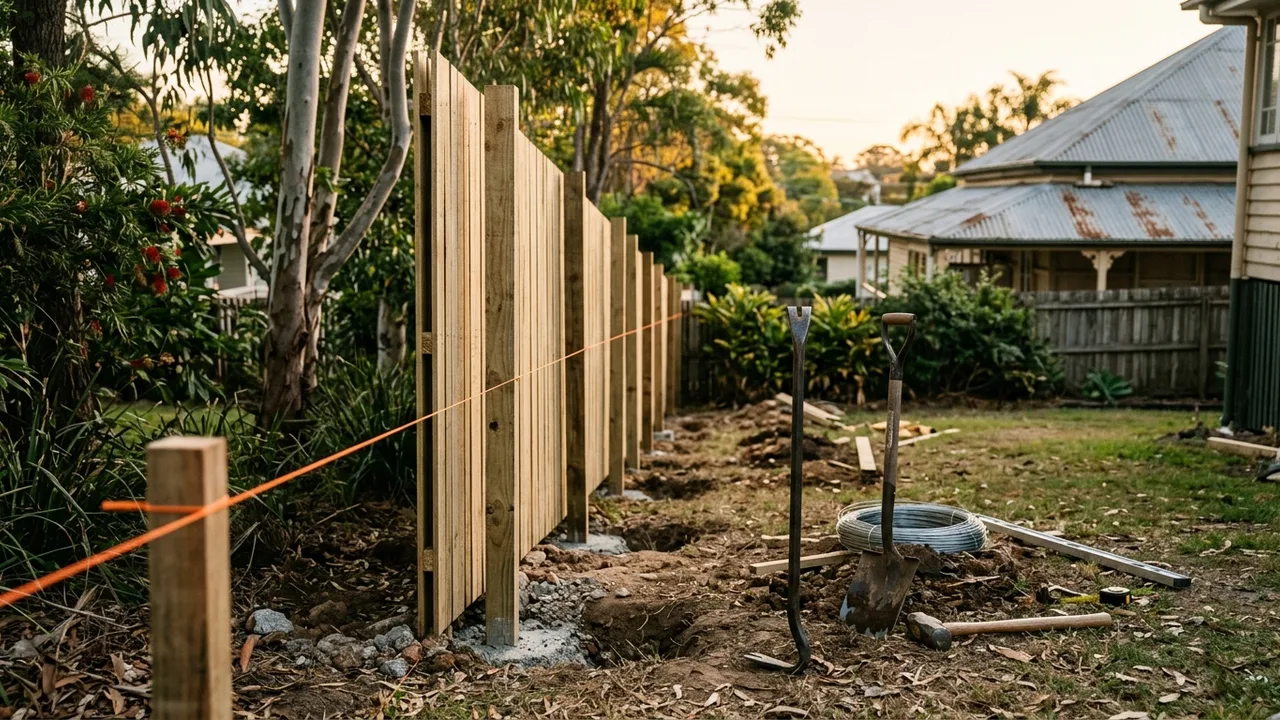
Post setting is unforgiving. If a post goes in at the wrong depth or angle, everything downstream is crooked or weak. Hardwood posts in Brisbane's clay-heavy soils (common through the Inner West) can be stubborn. The general rule is one-third of the post length below ground, plus concrete for stability, but in reactive clay, waterlogged conditions, or on sloped ground, it takes experience to get that right.
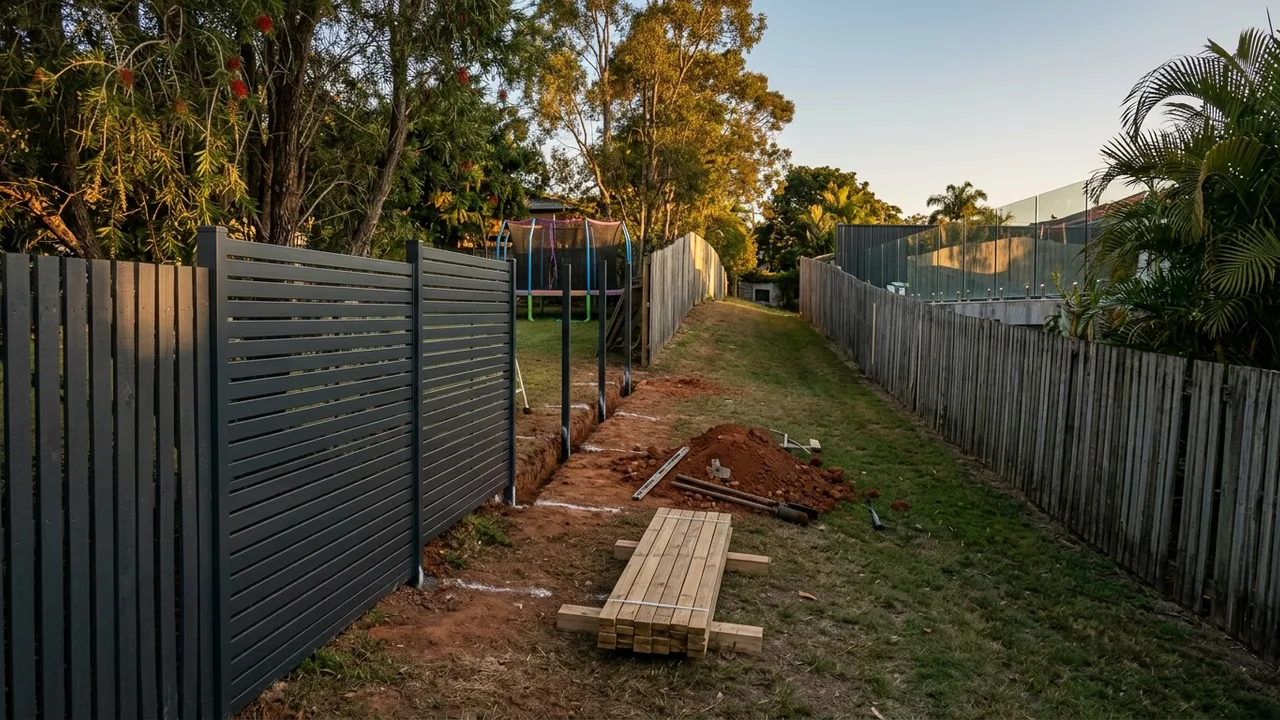
Sloped blocks create a sequencing problem. Do you step the fence or rake it? Stepping looks tidier with Colorbond panels; raking works better with some timber styles. The decision affects how you measure, order, and install everything. Get it wrong and you're left with large gaps or a fence that doesn't line up with gates, neighbouring fences, or your own landscaping.
Timber selection matters more than most people realise. A pine paling fence built with untreated or under-treated timber in Brisbane's humid subtropical climate can start deteriorating within a few years. Hardwood like treated ironbark or merbau holds up significantly better but is harder to work with and more expensive per metre. If you're sourcing your own materials, understanding the difference between H3 and H4 hazard class treatment (relevant for in-ground posts) is genuinely important.
Tools and equipment. A basic paling fence on flat ground needs a post-hole digger, level, saw, and a concrete mix. A 40-metre Colorbond fence on a Chelmer block with a 600mm fall needs more, including possibly a string line and pegs, a laser level, and the ability to cut steel panels cleanly. Hiring equipment adds cost to the DIY option that people often forget to factor in.
The Honest Cost Comparison
A rough numbers comparison for a typical Inner West Brisbane property:
DIY paling fence, 20 metres, flat ground:
- Materials (treated pine posts, palings, rails): roughly $800-$1,200
- Concrete, hardware, fixings: $100-$200
- Tool hire (post-hole digger, etc.): $80-$150
- Your time: a full weekend, maybe two
Professionally installed equivalent:
- Total installed cost: typically $1,500-$2,800 for the same 20-metre run
So the saving on a simple job can be $500-$1,000. On a bigger, more complex job (sloped block, retaining element, Colorbond, pool barrier) the price range for professional installation shifts considerably, often $4,000-$10,000 or more depending on scope, but so does the complexity and the risk of getting it wrong.
The honest trade-off: the monetary saving on a simple DIY fence is real but modest once you account for materials, hiring equipment, and two weekends of your life. On anything complicated, the risk of mistakes and the cost of fixing them often closes that gap quickly.
Where Professional Installation Makes Clear Sense
There are situations where hiring a professional fencer is simply the better decision, and it's worth saying that plainly.
- Pool fencing, for the reasons above. The certification requirements are not something to guess at.
- Combined retaining and boundary fences on sloped blocks. This is structural work and the stakes, both physical and financial, are high.
- Shared boundary fences where your neighbour is contributing costs. If they're paying half, they reasonably expect a professional result and documentation.
- Front boundary and street-facing fences where the result is highly visible. A fence that's 10mm out of true on your back fence bothers only you. On a streetfront in Indooroopilly or Yeronga, it's the first thing anyone sees.
- Large jobs over 30-40 metres, where small errors compound and physical endurance becomes a real factor.
- Any project involving a heritage or character overlay, which applies to many Queenslander-era streets in the Inner West. Brisbane City Council has specific guidelines for fencing in character residential zones, and a professional fencer working locally will know them.
Where DIY Can Work Well
A straightforward timber paling fence on a flat block, within a property boundary (not a dividing fence requiring neighbour negotiation), with no pool involvement and no retaining element, is a reasonable DIY project for someone who is handy, has time, and is willing to do the research.
Small repairs, like replacing a few palings after storm damage or reseating a post that has shifted, are also sensible DIY territory. Fencing Indooroopilly does take on repair and replacement jobs, but we'd rather you save money on something genuinely manageable yourself.
A Closing Recommendation
The answer isn't "always hire a professional" or "you can always do it yourself." It's more specific than that.
If your fence project is simple, your block is flat, and there's no pool, no retaining element, and no character overlay to navigate, a capable DIYer can produce a decent result and save a few hundred dollars. Go in with realistic expectations about time and effort.
If your block is sloped (and a lot of properties in Indooroopilly, Taringa, St Lucia, and Graceville are), if there's a pool involved, if you're sharing the fence with a neighbour, or if you're putting something visible on the street frontage, a professional is the more sensible choice. The extra cost buys you a result that's structurally sound, legally compliant, and not something you'll have to redo in two years.
If you're sitting on the fence about it (sorry), it costs nothing to get a quote and compare that number against what a DIY version would actually cost you in materials, time, and hire fees. That comparison usually makes the decision obvious.
If you'd like to talk through what a job like yours might realistically involve or cost in this part of Brisbane, we can connect you with a local fencing contractor who works in these suburbs. No pressure, just a useful conversation.
Quick answers