Fencing guide
Who pays for a boundary fence in Queensland? The rules are clearer than you think.
Who Pays for a Boundary Fence in Queensland? The Rules Are Clearer Than You Think
The short answer: you and your neighbour split the cost equally. That's the default position under Queensland's Neighbourhood Disputes Resolution Act 2011, and it applies across the state, including every suburb in Brisbane's Inner West. There are exceptions, situations where one party pays more or less, but the equal-share rule is where every conversation should start.
What the Law Actually Says
Queensland's Neighbourhood Disputes Resolution Act 2011 (NDRA) is the governing legislation. It replaced older, patchier rules and made the process considerably more straightforward.
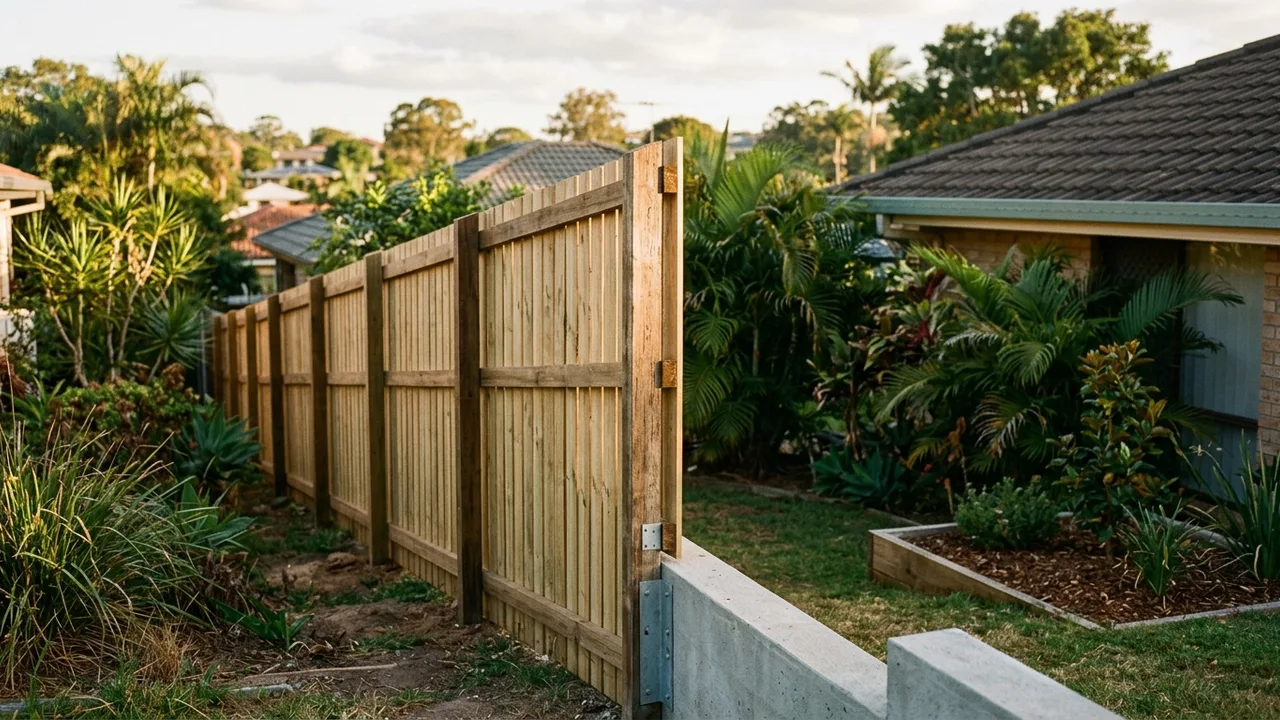
The NDRA defines an "adjoining owner" as anyone who shares a common boundary with you. Both of you are responsible for contributing equally to the cost of a dividing fence — which the Act defines as a fence that separates your land from theirs. That includes new fences, replacements and, in most cases, repairs to an existing structure.
A few things the Act does not do:
- It does not require your neighbour to use your preferred contractor.
- It does not force them to agree to a more expensive material than what is "sufficient for the purpose."
- It does not make the council responsible. Councils in Brisbane do not generally contribute to private boundary fences.
The Act does give you a formal process to follow if your neighbour refuses to engage. More on that below.
The "Sufficient Fence" Standard (and Why It Matters in Inner West Brisbane)
The Act uses the phrase "sufficient dividing fence." This is deliberately vague, because what's sufficient depends on context: the zoning of the land, what's on each property, and local norms.
In practical terms for suburbs like Indooroopilly, Taringa, St Lucia and Chelmer, a sufficient fence for a standard residential block is typically a 1.8-metre timber paling or Colorbond steel fence along the side and rear boundaries. That's what most fencing contractors price as a baseline, and it's what a dispute resolution body would likely consider adequate.
Where it gets interesting is when one owner wants an upgrade. Say your neighbour is happy with standard pine paling, but you want a hardwood timber fence or a custom Colorbond colour. The law says your neighbour only has to pay their half of the "sufficient" option. If you want the premium version, you cover the difference yourself.
So if a standard fence costs $4,000 and your preferred fence costs $6,000, your neighbour's fair contribution is $2,000. You pay $4,000. That's a reasonable trade-off if the upgrade genuinely matters to you.
Sloped Blocks, Retaining Walls and the Complications They Bring
This is where Inner West Brisbane gets its own wrinkle. Suburbs like Sherwood, Corinda, Graceville and Yeronga sit on undulating ground. Many blocks have a significant fall from street to back boundary, and fences on those sites often need to sit on a retaining wall or step down the slope in sections.
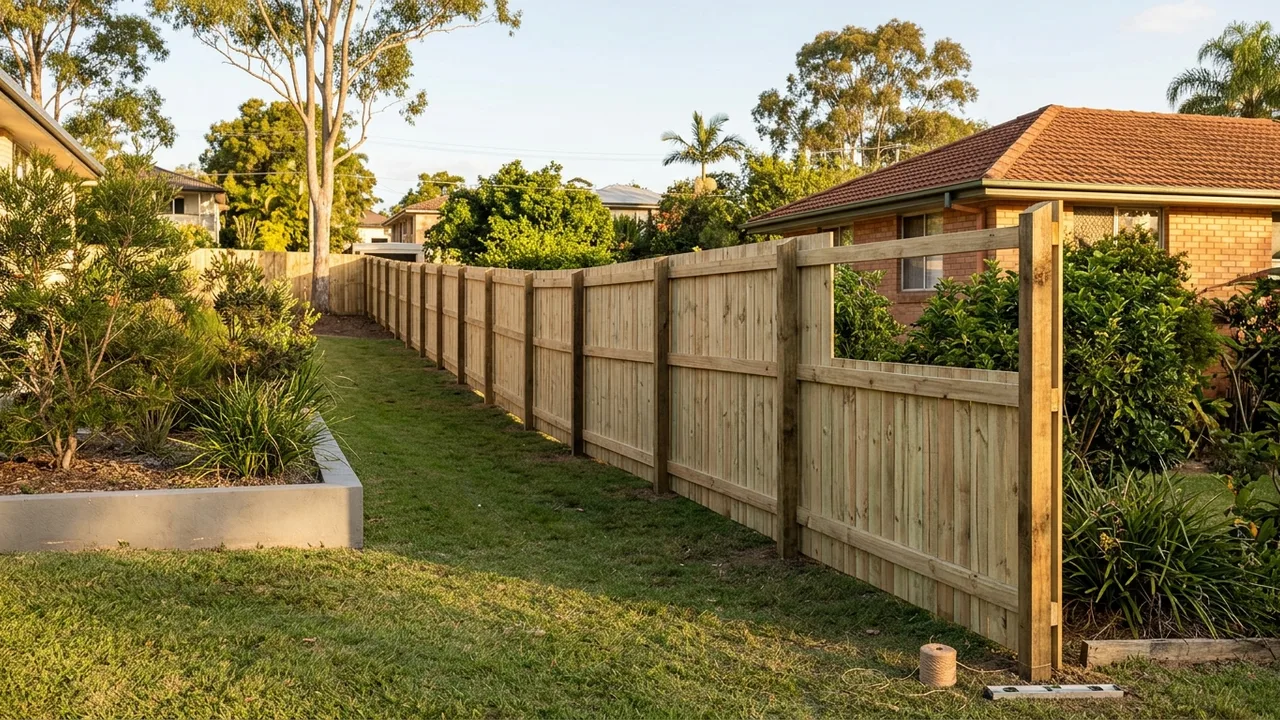
Retaining walls are not dividing fences under the NDRA. The cost-sharing rules do not automatically apply to a retaining structure. If the retaining wall solely benefits one property (for example, holding up a raised garden bed on your side), that owner typically bears the full cost of the wall. The fence that sits on top of it may still be split equally.
In practice, the split between "wall" and "fence" costs can be contested. Getting a written quote that separates the two line items is worth the effort before you approach your neighbour. It avoids arguments later.
For steeply sloped blocks in areas like Moorooka or Fairfield, combined retaining-and-fence solutions are common. These jobs typically run higher than a standard flat-block fence, often sitting in the $5,000 to $12,000 range depending on height, materials and access. Getting clarity on who pays for what before work starts is essential.
How to Approach Your Neighbour (The Right Way)
The NDRA requires you to give your neighbour a formal Fencing Notice before proceeding with work in most circumstances. This is a written document that sets out:
- What work you're proposing
- The materials and height
- The estimated cost
- The contractor you intend to use
- Each party's proposed contribution
You don't need a lawyer to write one. The Queensland Government provides a template. You hand-deliver it or send it in a way you can prove was received.
Your neighbour then has 30 days to respond. They can agree, propose an alternative, or do nothing. If they do nothing, you can generally proceed with the work and then recover their share through the Queensland Civil and Administrative Tribunal (QCAT) if they refuse to pay.
A few practical notes from people who have been through this process:
- Talk first, notice second. A conversation over the fence (pun intended) often resolves things before paperwork is involved.
- Document everything in writing, even a text message exchange, once you move beyond the initial chat.
- If your neighbour is a tenant, the notice usually goes to the property owner (landlord), not the tenant.
Urgent Repairs: Who Pays When a Fence Falls Down?
Storm damage is a particular reality in Brisbane. After a severe event (and this part of Brisbane's Inner West gets its share of afternoon storms), a shared fence can come down overnight.
If the fence needs urgent repair to prevent a genuine hazard, you can act without giving the full 30-day notice. The Act allows you to carry out urgent repairs and then seek cost recovery from your neighbour afterward. You still need to notify them as soon as reasonably possible.
In reality, most neighbours are cooperative after storm damage because they've both seen the problem happen. The harder cases involve fences that have deteriorated slowly over years, where one owner wants to replace it and the other doesn't see the urgency.
For fence repairs and post replacements in the Inner West, costs vary considerably by the extent of damage. Replacing a few panels and posts might sit around $800 to $2,000; a full-section rebuild after storm damage can push higher depending on material and access.
Exceptions Worth Knowing
Most of the rules above apply to residential land. There are situations where the equal-share default doesn't hold:
- If you build a fence solely for your own benefit (for example, an internal dividing fence within your own property, or a fence the neighbour can demonstrate they gain nothing from), you may bear more or all of the cost.
- Livestock fencing has different provisions under the Act, relevant if you're near semi-rural pockets on Brisbane's fringe.
- New subdivisions sometimes have developer-built fences on boundaries, and the legal position on who maintains those can be complex.
- Heritage or character overlays in some Inner West suburbs may affect what materials or styles are permissible, which can affect cost calculations.
A Sensible Way Forward
If you're planning a new boundary fence or dealing with a failing one, the most useful thing you can do before spending a cent is get a written quote. Not to lodge a Fencing Notice immediately, but so you know what you're actually talking about when you knock on your neighbour's door.
An itemised quote, one that separates fence from any retaining work, shows your neighbour you've done this properly. Most people respond better to a specific number than a vague request for "half." It also gives you a firm figure to put in a Fencing Notice if the conversation goes that way.
The law genuinely is on your side here, in the sense that it gives you a clear process and a clear default. You don't need to guess or rely on goodwill alone. But working with your neighbour rather than around them almost always produces a faster, cheaper and less stressful outcome.
If you'd like a local fencing contractor in the Indooroopilly area to quote the job and help you understand what a sufficient fence looks like for your specific block, that's a reasonable first call to make.
Quick answers